Companies now have to deal with increasingly complicated attacks that could jeopardize their data, systems, and reputation in the rapidly evolving field of cybersecurity. To protect their assets from a range of dangers, firms must employ cutting-edge security solutions.
As a result, Craw Security's ShieldXDR is a unique product or solution from the company, which is a top supplier of cybersecurity services and training that offers complete threat protection to companies of all sizes.
Artificial Intelligence | Machine Learning | Analytics
ShieldXDR, which comes from the House of Craw Security, is a powerful security solution that quickly detects and gets rid of complex threats by utilizing state-of-the-art technologies like artificial intelligence (AI), machine learning (ML), and behavioral analytics.
By combining cloud, network, and endpoint security into one platform, it offers a comprehensive approach to threat identification and reaction. Businesses can respond quickly to any security event that may occur at any time from any remote hacker sitting anywhere in the world, since Shield XDR provides monitoring and notifications 24X7.
Shield XDR's cutting-edge endpoint security technology guards against malware, ransomware, and other contemporary threats that could compromise endpoints. The use of AI and ML algorithms enables real-time detection and reaction to zero-day attacks. Craw Security's ShieldXDR stands out from a number of other XDR solutions on the market that charge more and provide fewer services in comparison to the price.

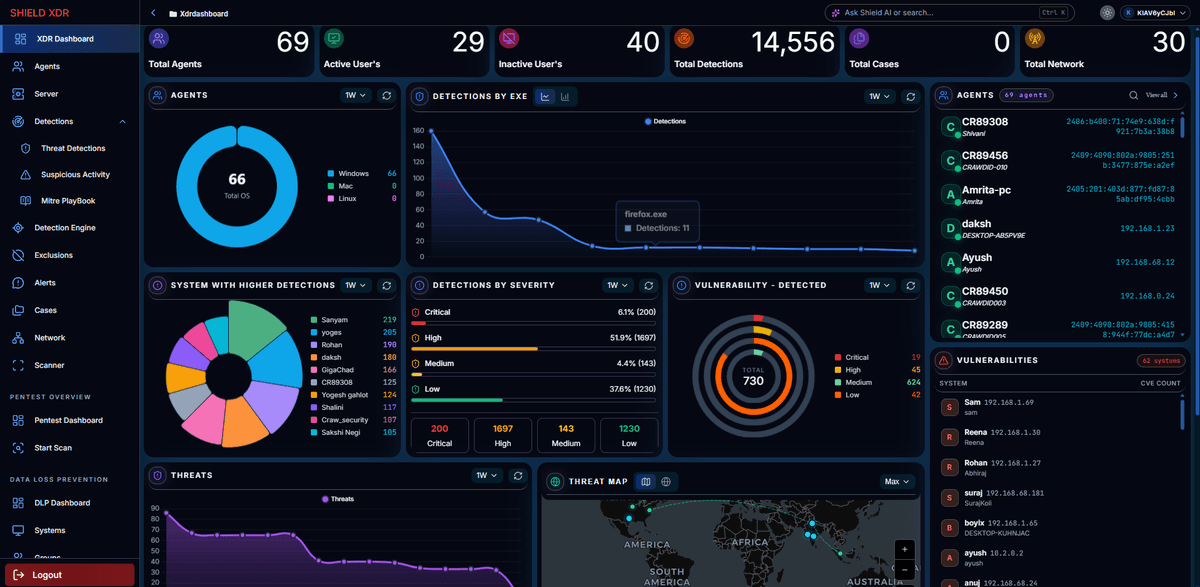
XDR systems provide a single view of security data across servers, networks, endpoints, and cloud environments. This improved visibility allows security professionals to detect threats faster, eliminate blind spots, and respond more skillfully by connecting events from several sources.
Effective alert management in XDR systems helps security analysts avoid being overwhelmed with false positives and instead warns them of actual risks. Advanced filtering, prioritization, and aggregation tools expedite the alert review process, increasing incident management speed and accuracy.
Automation in XDR simplifies repetitive security tasks like threat hunting, alert triage, and early incident response. This reduces the manual workload, expedites response times, and ensures consistency in security operations.
XDR systems coordinate activities across several security products (firewalls, EDRs, SIEMs, cloud security solutions, etc.) to ensure a coordinated response. This integration streamlines workflows and allows for the rapid and automatic containment and remediation of hazards across the whole organization.
Artificial intelligence and machine learning in XDR systems enhance threat detection by identifying advanced persistent threats (APTs), aberrant patterns, and zero-day attacks that traditional signature-based methods may miss.
XDR solutions monitor discussions on dark web sites on targeted attacks, compromised credentials, and leaked data. By identifying such activity early on, organizations can take preventive action before a breach impacts them.
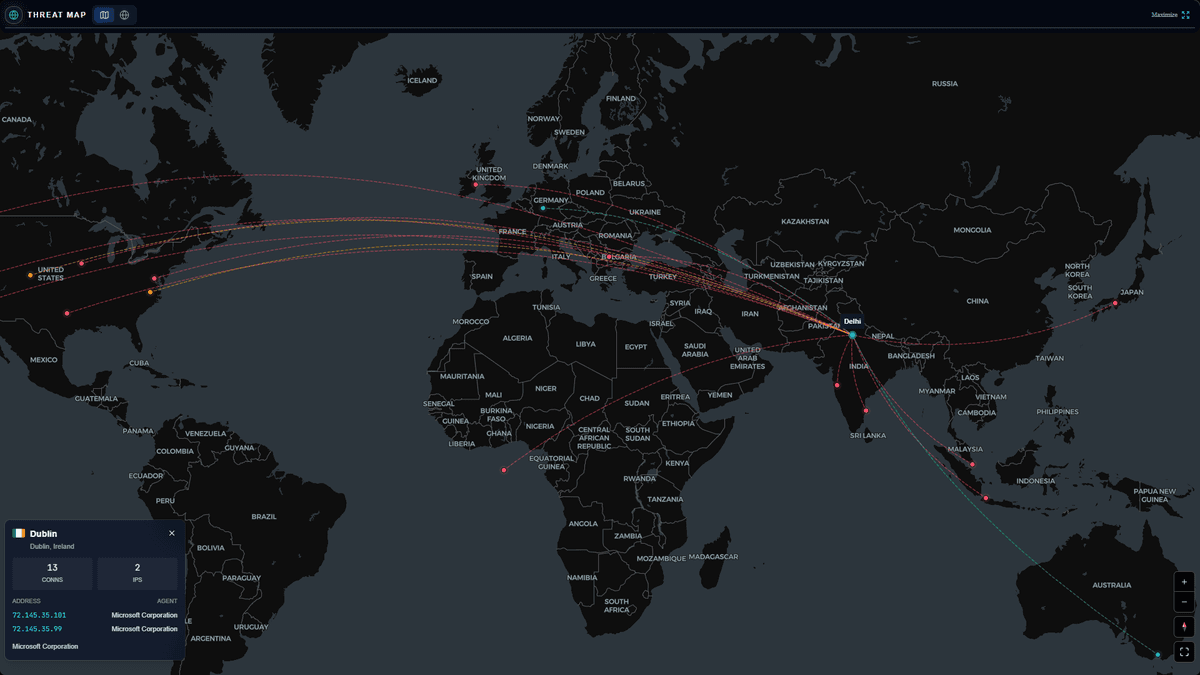
An XDR (Extended Detection and Response) IP surveillance output dashboard centrally displays all IP-related events, actions, and threats relating to a company's network. To give users real-time access to IP traffic and any security risks, the dashboard gathers data from a variety of sources, including intrusion detection systems, firewalls, network security appliances, and endpoint agents.
The general portion of the dashboard typically opens with a high-level summary of the IP monitoring operations. Key indicators, including the overall number of IP interactions, threats discovered, and traffic patterns, might be presented.
This section's primary focus is on the analysis and actions of IP traffic trends. The amount of traffic, the origin and destination locations, and other information can be shown using graphs, charts, and heatmaps.
This dashboard section's main focus is on IP monitoring-related real-time alerts and notifications. It might draw attention to violations of the law, unusual intellectual property activity, or urgent security occurrences.
The "IP Traffic Map" interface of an XDR (Extended Detection and Response) architecture shows network traffic patterns according to IP addresses. It provides information on the global distribution of connections on the network and illuminates the initial sources and destinations of network traffic. Although the specific data and features may vary depending on the XDR platform or provider, an IP Traffic Map dashboard typically consists of the following elements.
Real-time visualization of global network activity and threats.
Each arc represents live data flow between source and destination.
Helps detect suspicious IP connections and threat origin points.
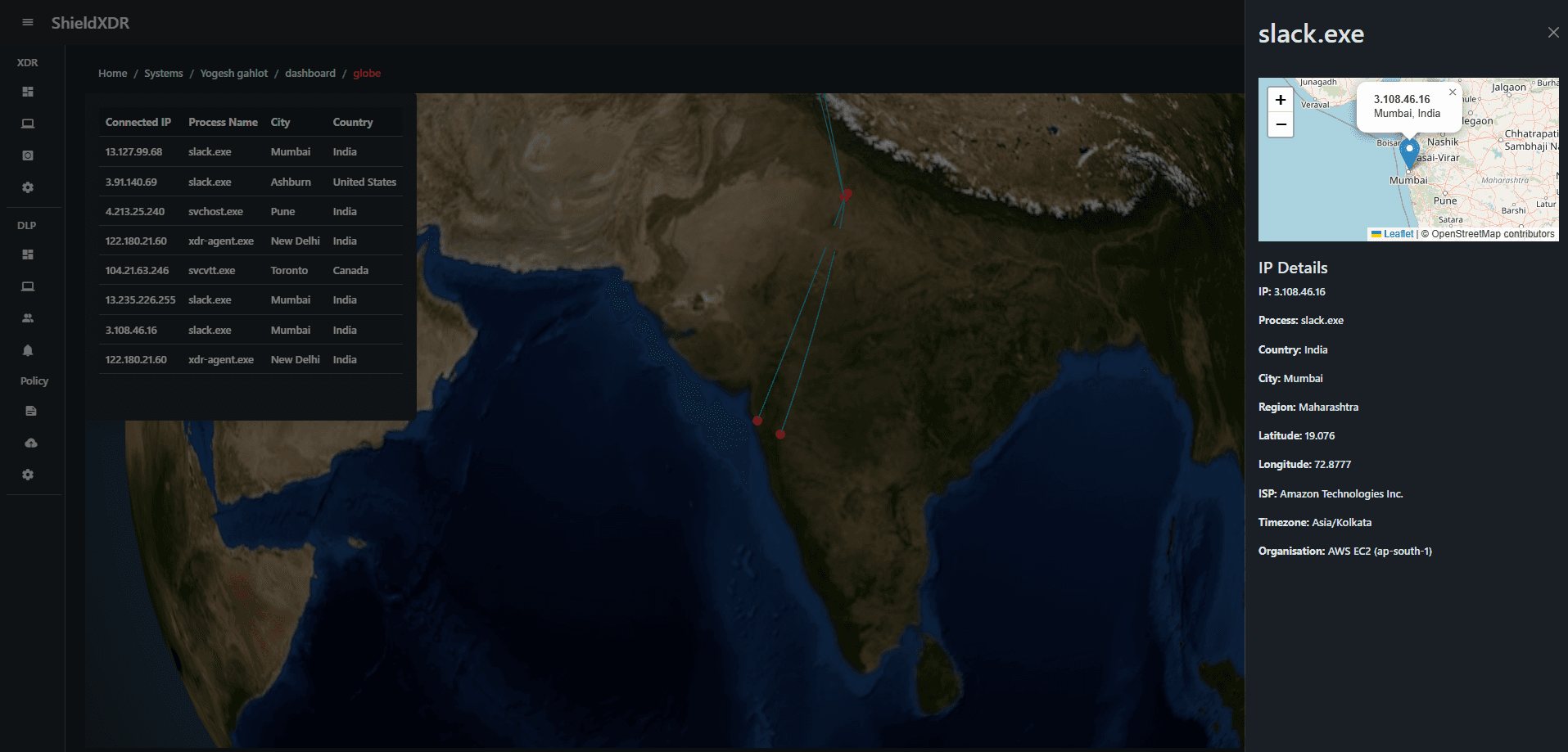
Although the specific data and features may vary depending on the XDR platform or provider, an IP Traffic Map dashboard typically consists of the following elements.
An illustration of a world map showing the locations of the nations or territories that are crucial to network traffic. The distribution of IP addresses used in network connections worldwide can be seen with this visualization.
The amount of network traffic between IP addresses is shown by the map's links' thickness or magnitude. Thinner lines indicate lower traffic levels, whereas thicker lines indicate higher traffic levels.
Lines or arrows are used to visually represent links between several IP addresses. In addition to other network-related operations, these connections may entail server-to-server and client-server communications.
An XDR (Extended Detection and Response) platform's background operation dashboard offers information on the state and efficacy of several background processes and tasks that promote activity safety. A process's background dashboard typically has the following elements, but the precise data shown may differ based on the XDR platform or vendor.
Many port files can provide useful information for monitoring and enhancing cybersecurity. Ports are used as communication endpoints in many network protocols. Potential security flaws, hostile behavior, and unauthorized access attempts can all be identified by security experts. The following compilation of alarming logs emphasizes their significance for cybersecurity.
For email security, SMTP (Simple Mail Transfer Protocol) logs are essential. They might assist in spotting questionable email activity that might point to a compromised account, such as spam and phishing efforts.
Web traffic can be examined using HTTP (Hypertext Transfer Protocol) and HTTPS (HTTP Secure) records. These log files may expose serious security flaws like SQL injection, web application attacks, cross-site scripting, and odd file uploads.
Logs used to identify anomalous network activity, such as port scanning, brute-force attacks, and unauthorized service access, contain two crucial transportation layer systems: Transmission Control Protocol and User Datagram Protocol connection data.
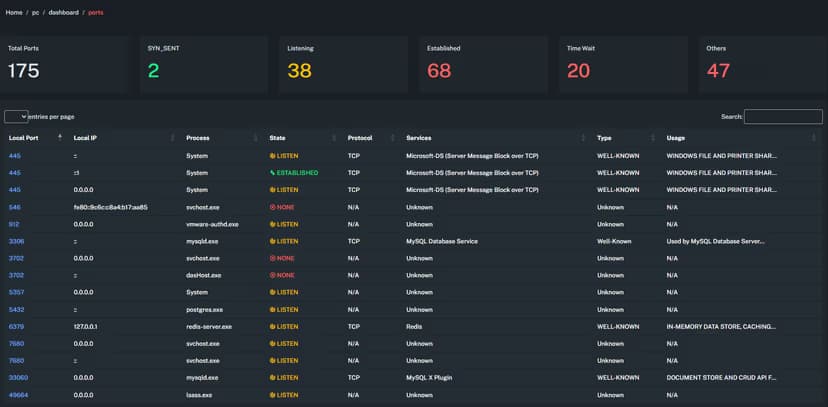
XDR systems ingest live threat intelligence feeds to deliver up-to-date information on malicious IPs, domains, indicators of compromise (IOCs), and new threats. This enables proactive defense and faster identification of potential threats.
XDR helps companies manage vulnerabilities, monitor assets, and respond quickly to events that affect specific resources by maintaining an up-to-date inventory of all endpoints, servers, and devices.
By identifying and reporting any unauthorized access or exfiltration of sensitive data within the organization, the system enables a prompt response to manage and address breaches at the earliest stage.
XDR's end-to-end incident management capabilities, including playbook-driven reaction, automated investigation, evidence collection, and comprehensive reporting, enable quick and well-organized handling of security incidents.
XDR solutions usually include DLP features to detect and stop unauthorized transmission of sensitive data via email, web uploads, portable media, or cloud services in order to protect private information.
Built-in device control features assist in preventing virus introduction, undesired data transfers, and data leakage through detachable devices by monitoring and restricting USB and other external media.
XDR platforms can identify or prevent unauthorized screenshots, safeguard confidential on-screen information, and prevent accidental or intentional data exfiltration.
ShieldXDR offers comprehensive support for fulfilling the prerequisites for a number of top-tier certifications and frameworks.
XDR platforms can help businesses establish and maintain the rules required for ISO certification by centralizing security monitoring, reporting, and incident response capabilities.
With capabilities like data access monitoring, breach detection, and thorough audit logs, XDR solutions meet GDPR requirements for protecting personal data and disclosing breaches within the allotted period.
XDR solutions assist businesses in adhering to NIST cybersecurity rules by offering capabilities for continuous monitoring, threat detection, incident response, and evidence gathering.
You can take a number of useful steps with the help of this incredibly helpful Shield XDR software that will greatly increase the security of every device in your company's IT infrastructure.
XDR systems employ enhanced correlation techniques to find patterns and connections among various events. This makes it simpler to identify possible dangers or questionable behavior, such as various systems or network elements.
XDR systems gather and aggregate data from your network's endpoints, servers, cloud infrastructure, and network hardware. Examples of this data include network traffic, events, logs, and endpoint telemetry.
The collected data is then standardized to preserve a consistent format inside an organization. Because different sources may have different log structures and data representations, this step is crucial.
Businesses should adopt Shield XDR as their primary security solution for several reasons. First off, ShieldXDR offers comprehensive attack prevention by combining network security, cloud security, and endpoint high security into a single system.
This makes understanding easier and provides a thorough overview of the company's safety position. Furthermore, Shield XDR uses state-of-the-art technologies like artificial intelligence (AI), machine learning (ML), and behavioral data analysis to swiftly identify and eradicate complicated threats.
Businesses ensure security from the latest threats by doing this. Finally, Shield XDR provides 24X7 monitoring and alerting so that companies can respond quickly to any security incident. In this case, it minimizes the impact of a security breach while allowing businesses to continue operating.